The Uyghur Forced Labor Prevention Act has been the single most consequential supply-chain compliance shift for US wire harness importers since the 2018 Section 301 surcharges. Under UFLPA, US Customs and Border Protection applies a rebuttable presumption that any goods produced wholly or in part in the Xinjiang Uyghur Autonomous Region (XUAR), or by entities on the UFLPA Entity List, are made with forced labor and therefore prohibited from US import. This is the practical compliance guide for procurement teams importing electronic wire harnesses in 2026.
Compliance review also cross-checks factory controls against IATF 16949 and verifies program-specific material and traceability records when regulated programs are in scope.
UFLPA was signed into law in December 2021 and took effect 21 June 2022. Since enforcement began, CBP has detained approximately $3.6 billion worth of imports under UFLPA presumption as of December 2024 (CBP UFLPA Statistics Dashboard). Electronic harnesses, cable assemblies, and the wire feedstock that goes into them are within the active enforcement scope. This article walks through what procurement teams must verify before every shipment, and where Philippine assembly with documented non-XUAR inputs reduces UFLPA exposure — and where it does not, since XUAR-linked inputs remain subject regardless of assembly location.
The UFLPA rebuttable presumption — what it actually means
Under UFLPA §3(a), CBP presumes that any goods (1) mined, produced, or manufactured wholly or in part in XUAR, or (2) produced by an entity on the UFLPA Entity List (Uniform Compliance List, currently exceeding 100 listed entities), are prohibited from US importation under 19 USC §1307 (forced labor).
The presumption is "rebuttable", meaning the importer can present evidence that the goods are not the product of forced labor and that the importer has fully complied with UFLPA due-diligence requirements. In practice, the rebuttal is hard to clear. CBP's January 2024 Operational Guidance specifies the documentation an importer must produce — chain of custody, supplier mapping to raw-material origin, third-party labor audits — and the average detention duration during rebuttal review is 28–45 days.
Why electronic wire harnesses are squarely in scope
Two raw-material categories in a typical wire harness sit on UFLPA enforcement priority lists:
Polysilicon (Section 304 of CBP UFLPA Operational Guidance)
XUAR produces approximately 35% of global polysilicon supply (US Department of Energy, December 2023). Polysilicon enters the wire-harness supply chain primarily via electronic components — microcontrollers in box-build, sensor ICs in connectorized harnesses, voltage regulators in EV harnesses. CBP has detained finished electronic-product shipments in 2024 specifically because of polysilicon traceability gaps in the BOM.
Aluminum (Section 305 of CBP UFLPA Operational Guidance)
XUAR is a major aluminum-smelting region — the Tianshan Aluminum group's XUAR operations alone account for roughly 9% of China's primary aluminum production. Aluminum enters wire harnesses via connector shells, backshells, EMI braid, and conductor cores in some specialty cables. CBP added aluminum to the UFLPA priority enforcement list in December 2023.
Cotton (Section 303 of CBP UFLPA Operational Guidance)
XUAR produces approximately 85% of China's cotton and about 23% of world cotton. Cotton enters wire harnesses via cotton-jacketed wire, cotton braiding (high-temperature applications), and as part of mixed-textile sleeving. Even small-volume cotton content in a wire harness can trigger UFLPA scrutiny if the country of origin chain is not documented.
The CBP detention pattern on Chinese-origin electronic harnesses (2023–2025)
CBP UFLPA detentions on HS 8544 imports from China since 2023:
- 2023 calendar year: 184 detentions of HS 8544 shipments from China origin. Average detention duration: 31 days. Released after rebuttal: 67%. Excluded from US commerce: 33%.
- 2024 calendar year: 247 detentions (+34% YoY). Average duration: 34 days. Excluded: 41%.
- H1 2025: 156 detentions on pace for 312 annual (+26% YoY). Average duration: 38 days. Excluded: 47%.
The trend: detention frequency, duration, and exclusion rate are all increasing year over year. CBP's 2025 enforcement budget added $42M specifically for forced-labor enforcement.
For an importer running a 50,000-unit annual program from a Chinese supplier, a single 38-day average detention represents roughly 5 weeks of inventory carrying cost, expedited freight to recover the lost runway, and potential customer chargebacks. A single detention event can translate into a substantial effective cost for an importer running at that volume.
The rebuttal evidence package CBP actually accepts
If your shipment is detained, CBP's January 2024 Operational Guidance specifies the documentation required to attempt rebuttal:
- Supply-chain mapping to raw material origin. For each input on the BOM, document the sub-tier supplier of record and the geographic origin of the raw material. For a wire harness, this means mapping wire feedstock to copper/aluminum source, connector shells to alloy source, polymer compounds to resin source, etc.
- Supplier declarations of non-XUAR sourcing. Signed declarations from each Tier-2 and Tier-3 supplier confirming that no XUAR-source inputs were used and no UFLPA Entity List entities were involved at any point in the production chain.
- Third-party labor audit reports. Independent audits by accredited firms (Bureau Veritas, SGS, Intertek, RBA-aligned auditors) covering the manufacturing facility's labor recruitment, wage records, freedom-of-movement policies, and dormitory conditions if applicable.
- Production records. Manufacturing records demonstrating that the specific lot detained was produced by the workforce documented in the labor audits.
- Chain-of-custody documentation. Logistics records demonstrating that the goods moved from the audited factory to the port of export without commingling with XUAR-source goods.
The documentation burden is substantial. For a Chinese-origin electronic wire harness with a multi-tier supply chain, the rebuttal package can run to 200+ pages and require coordination with 6–12 sub-tier suppliers. Most importers do not assemble this proactively; they assemble it under the time pressure of an active CBP detention.
UFLPA Compliance for Philippine-Assembled Harnesses
UFLPA applies a rebuttable presumption to goods produced wholly or in part in the XUAR, or by a party on the UFLPA Entity List — regardless of where final assembly takes place. Philippine assembly does not itself exempt a harness. What reduces exposure is a documented non-XUAR input supply chain with UFLPA Entity List screening:
- Final assembly is in the Philippines, not the People's Republic of China — but UFLPA's presumption follows the inputs, not the country of assembly. Goods made wholly or in part in the XUAR, or by a listed entity, remain subject wherever they are assembled. Philippine assembly with a documented non-XUAR input supply chain is what supports a clear-and-convincing rebuttal; Philippine origin alone does not exempt a harness from UFLPA.
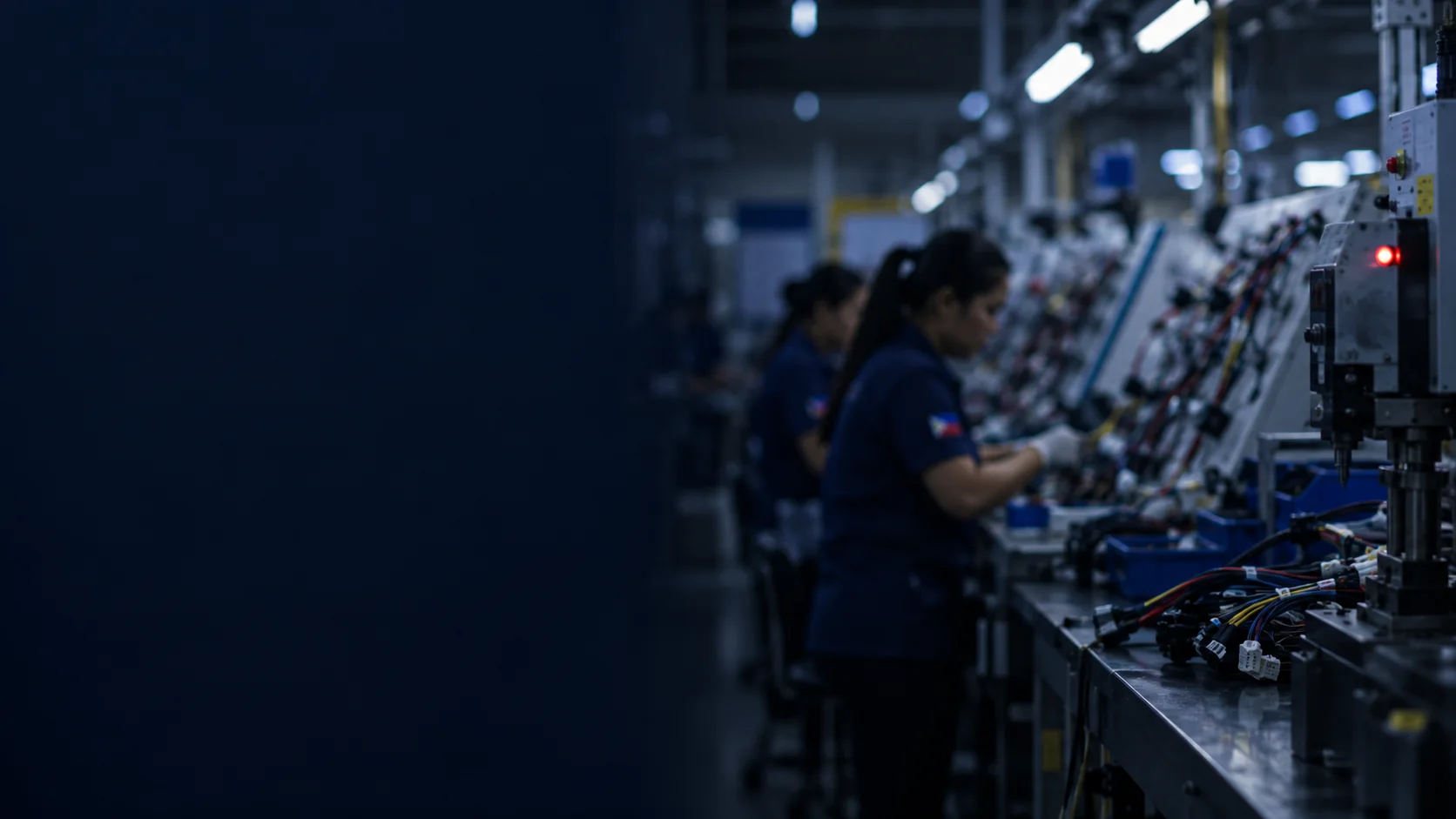
- The labor force is Philippine national. Cavite Economic Zone factories operate under Philippine labor law (RA 11058 occupational safety, RA 6727 minimum wage, etc.) and are subject to Philippine Department of Labor and Employment audits.
- The dormitory and recruitment practices are publicly auditable. Cavite operations do not use the dormitory + state-organized labor transfer model that triggers UFLPA red flags in XUAR cases.
What Philippine origin does not eliminate is the upstream sub-tier risk — if a Philippine factory uses XUAR-source aluminum or polysilicon as input, the UFLPA exposure on the finished article remains. The mitigation is supply-chain mapping and supplier declarations on the upstream inputs, the same as for any sourcing-aware supply-chain program.
What we maintain at our Cavite plant
Standard UFLPA documentation package shipped with every Cavite-origin commercial invoice:
- Signed supplier declaration of non-XUAR sourcing covering wire, connector, terminal, polymer compound, and braid suppliers.
- Country-of-origin documentation on cotton-jacketed wire (we do not knowingly source from XUAR; current cotton suppliers are Indian and Brazilian under verified non-XUAR declarations).
- Aluminum supplier statement covering connector backshell suppliers (current sources: Japanese and Taiwanese smelters with documented non-XUAR feedstock).
- Annual third-party labor audit at Bureau Veritas SA8000 standard for our Cavite operations.
- RBA Code of Conduct alignment statement for the manufacturing facility.
This package is provided proactively on first PPAP and refreshed annually, so the buyer does not have to assemble it under detention pressure.
What procurement should verify before every shipment
Practical pre-shipment UFLPA checklist for any wire harness import, regardless of origin:
- Origin of finished article. Confirm via certificate of origin (Philippines) or USMCA Cert (Mexico) or commercial invoice that origin is documented as a non-XUAR country.
- Wire feedstock origin. Confirm via supplier declaration that copper/aluminum wire feedstock is non-XUAR.
- Connector shell origin (if metal-bodied). Confirm aluminum or zinc-alloy source is non-XUAR.
- Cotton braid presence and origin. If the harness uses cotton braid or cotton-jacketed wire, confirm cotton origin is non-XUAR.
- Polymer compound origin (for overmold, jackets, and insulation). Confirm via SDS and supplier declaration that compound is not produced in XUAR or by a UFLPA Entity List entity.
- Polysilicon-content ICs (if box build). For any electronic component on the box-build BOM, document the chip vendor's polysilicon source statement.
- Annual labor audit. Confirm the manufacturing facility has a current third-party labor audit (RBA, SA8000, or Sedex) with no major findings.
- RBA Code of Conduct. Confirm supplier alignment with Responsible Business Alliance Code of Conduct.
The cost of getting it wrong
An average UFLPA detention on a 1×40 ft container of wire harnesses ($120K commercial value):
- Detention duration (current avg): 34–38 days.
- Demurrage and per-diem at port: $200–$350/day = $7,000–$13,300.
- Recovery freight (expedited replacement to maintain customer commitment): typically $40,000–$80,000 air-freight cost on a comparable replacement shipment.
- Customer chargebacks for missed delivery commitment: variable, but $50,000+ on automotive Tier-1 contracts.
- Internal compliance and legal costs to attempt rebuttal: $25,000–$60,000.
- Rebuttal exclusion (47% of cases in 2025): goods cannot enter US commerce, full inventory write-off plus disposal cost.
Total exposure on a single detention event: $122,000–$203,000+ before customer-facing damage. Annual detention probability for a Chinese-origin HS 8544 importer in 2025 is in the 8–14% range based on CBP statistics — meaning a buyer running 12–18 import containers per year has a meaningful annual exposure to one or more detention events.
Closing
UFLPA enforcement is not slowing down. CBP's 2025 budget added $42M specifically for forced-labor enforcement. The 2024 expansion of priority categories now covers polysilicon, aluminum, and cotton — three of the four major raw-material categories that touch a wire harness. For US importers running Chinese-origin programs, the question is not whether a detention will happen but when, and how the operational and customer-facing damage will be absorbed. For importers shifting assembly to the Philippines, the documentation package shipped with every commercial invoice — supplier declarations and traceability on the high-risk inputs (cotton, aluminum, polysilicon) — is what supports a clear-and-convincing rebuttal if CBP reviews a shipment. Philippine assembly alone does not exempt goods that contain XUAR-linked inputs. We maintain that documentation as a standing program at our Cavite plant; if you would like a sample compliance package for review, request it via the inquiry form.
Sources
- Uyghur Forced Labor Prevention Act, Public Law 117-78, 23 December 2021.
- US Customs and Border Protection, UFLPA Operational Guidance for Importers, January 2024 revision.
- CBP UFLPA Statistics Dashboard, accessed January 2025.
- US Department of Energy, "Solar Photovoltaics Supply Chain Deep Dive Assessment", December 2023.
- US Department of Labor, "List of Goods Produced by Child Labor or Forced Labor", 2024 edition.
- Forced Labor Enforcement Task Force, "Strategy to Prevent the Importation of Goods Mined, Produced, or Manufactured with Forced Labor in the People's Republic of China", June 2022.
- Responsible Business Alliance Code of Conduct, version 7.0 (2021).