An automotive wire harness is the organized, bound-and-protected set of wires, terminals, and connectors that carries power and signals to every electrical device in a vehicle — the lights, sensors, motors, controllers, and battery. Instead of dozens of loose wires running point to point, a harness routes them as a single engineered assembly, cut to length, crimped to the right terminals, wrapped or sleeved for protection, and tested before it ships. It exists to make a vehicle's wiring reliable, repeatable, and serviceable across years of heat, vibration, and moisture. This guide covers what a harness is made of, sealed versus unsealed construction, how wire gauge and circuit protection are decided, why the connector is usually the hardest part to source, and how a harness is actually built and tested.
It is written for engineers, buyers, and program owners who are new to automotive wiring or briefing a supplier for the first time — enough to understand a drawing, ask the right questions in an RFQ, and know where the cost and the risk really sit. It stays deliberately at the fundamentals; the linked guides go deeper on each decision.
What a wire harness actually is
A harness is not just "wires in a bundle." It is a designed assembly with a fixed geometry: each wire has a defined gauge, color, and route; each end is terminated with a specific terminal in a specific connector cavity; and the whole thing is held to a branch-and-length layout that matches how it installs in the vehicle. That geometry is what lets the same part be built the same way every time and drop into the car in one motion. The value is in the discipline — the right wire, in the right place, terminated and protected the right way — not in the raw materials, which are inexpensive on their own.
The parts of an automotive harness
A harness is built from a small family of components, each doing one job:
- Wire (conductors). Stranded copper sized by gauge to the current it carries, with insulation rated for the temperature and chemicals of its location — thin-wall automotive insulations (e.g. TXL/GXL-type) under the hood, standard grades in the cabin.
- Terminals. The metal contacts crimped onto each wire end that actually make the electrical connection inside a connector. Terminal, wire size, and plating (tin or gold) have to match the mating half.
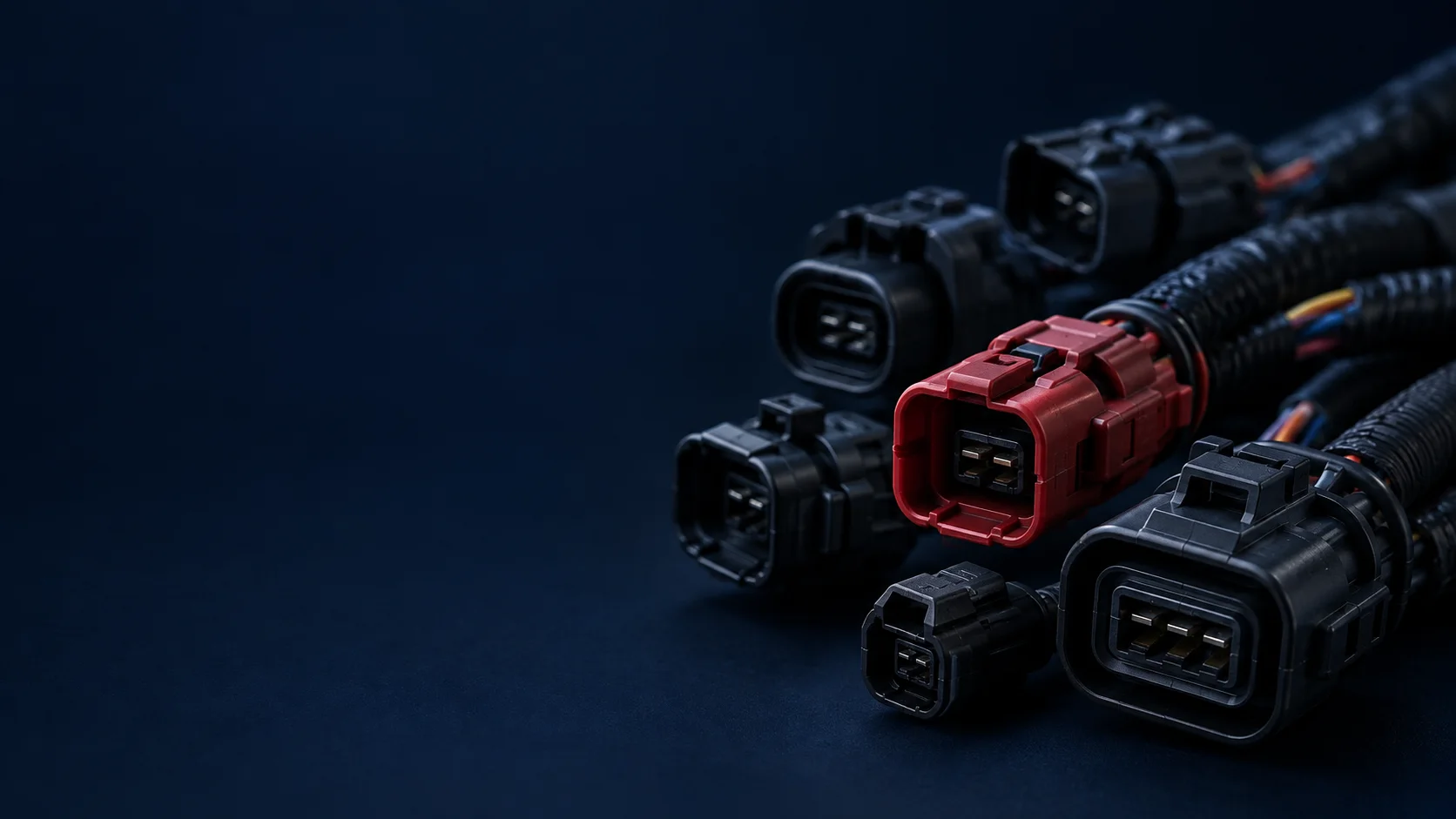
- Connectors. The plastic housings that hold the terminals and mate to the counterpart on the device or the next harness. The connector defines the interface — keying, polarization, and sealing — so it cannot be swapped casually.
- Protection. Convoluted conduit, braided sleeve, harness tape, or heat-shrink that shields the bundle from abrasion, heat, and chafe and holds branches together.
- Seals and grommets. Wire seals, cavity plugs, and pass-through grommets that keep moisture out of sealed connectors and out of the cabin where the harness crosses a bulkhead.
- Fixings. Clips, cable ties, and mounts that fasten the harness to the body on a repeatable route so it does not move, rub, or sag over the vehicle's life.
- Circuit protection. Fuses and, in some builds, relays or splices that protect each circuit and join wires where the topology branches.
Sealed versus unsealed — and why the environment decides
The single biggest construction choice is sealed versus unsealed, and in automotive it is driven by where the harness lives. An engine-bay, chassis, or underbody harness sees water, road spray, temperature swings, and oils, so it needs a sealed connector system — sealed housings, wire seals, and cavity plugs — from the start. A cabin harness in a dry, protected location can use an unsealed system. Getting this right up front matters because you cannot reliably add sealing to an unsealed connector after the fact; specifying a sealed family at design time is almost always better than bolting a boot onto the wrong connector later. Our application pages, such as the Philippines automotive wire harness work, carry the environment profiles that drive these choices.
Wire gauge and circuit protection
Each conductor is sized to two things: the current it must carry without overheating, and the acceptable voltage drop over its length. Undersizing a wire risks heat and drop; oversizing wastes cost, weight, and space in the bundle. The fuse or circuit protection is then chosen to protect the wire — the wire is the thing being protected, so the fuse rating follows the gauge, not the other way around. The full logic, including length and bundling effects, is laid out in our wire gauge selection decision tree.
Why the connector is usually the hardest part
Wire and terminals typically have several interchangeable sources, but a specific connector series — in a particular keying, plating, and sealing — often does not, and it defines the mating interface, so it cannot be quietly substituted. That makes the connector the part most likely to drive lead time and the part where authorized, traceable sourcing matters most. We source connectors through brand-authorized channels rather than open-market grey stock, precisely so the part on the drawing is the part in the harness. The selection logic behind each connector decision is covered in our wire harness connector selection guide, and the families a factory already tools are mapped on our wire harness connectors hub.
How an automotive harness is built
Building a harness is a sequence of controlled steps, and the discipline at each one is what separates a reliable assembly from a bundle of wires:
- Cut and strip. Each wire is cut to its drawing length and stripped to the terminal's strip length — too long or too short both weaken the crimp.
- Crimp. Terminals are applied with tooling matched to that terminal and wire size; a good crimp is verified by pull force and, periodically, by cross-section, not by eye alone.
- Insert and assemble. Terminals are loaded into the correct connector cavities and locked; seals and cavity plugs go in where the system is sealed.
- Lay up on a board. The harness is built on a form board that fixes the branch geometry and lengths, then taped, sleeved, or conduited and fitted with clips.
- Test. The finished harness is electrically tested for continuity and correct wiring, with hipot or sealing checks where the spec calls for them.
The workmanship is held to the industry standard IPC/WHMA-A-620 for crimp, assembly, and inspection acceptance, and the electrical checks are the same continuity, hipot, and pull tests described in our wire harness testing methods guide. Referencing A-620 is a statement about how the harness is built and inspected — a workmanship standard — not a claim about any specific certification.
Representative project (anonymized)
A North American EV OEM needed an urgent new-product-introduction (NPI) run for a new vehicle harness package — 50 prototype units within 15 days of the purchase order. The critical path was not the wire or the build; it was securing authorized Amphenol connectors fast enough, since the connector series defined the interface and open-market stock was not an option for a program part. The schedule was fast-tracked, the connector authorization and procurement were secured through the brand channel, and expedited logistics were coordinated to hit the deadline. The prototype batch shipped on time, which earned the customer's trust and a follow-on repeat program for the vehicle platform. The lesson maps straight onto the basics above: the connector is the long-pole part, and authorized sourcing is what let a tight automotive prototype actually ship. (Representative, anonymized; details generalized.)
What this means when you source an automotive harness
The fundamentals point to a few practical takeaways. Decide sealed versus unsealed from the environment before anything else. Size wire to current and length, then let the fuse follow the wire. Treat the connector as the part that drives lead time, and insist on authorized sourcing for it. And send a complete package so a factory can quote the real part — a drawing, a bill of materials, wire and connector part numbers, the environment, and your quantity. What drives the final number is set out in our custom wire harness cost factors guide, and the automotive application context sits on our Philippines automotive wire harness page.
FAQ
What is an automotive wire harness?
It is the engineered assembly of wires, terminals, and connectors — bound and protected as one unit — that distributes power and signals to the electrical devices in a vehicle. Rather than routing loose wires point to point, a harness fixes each wire's gauge, route, and termination into a repeatable part that installs in one motion and survives the vehicle's heat, vibration, and moisture.
What is a wire harness made of?
Stranded copper wire sized by gauge, terminals crimped to each wire end, connector housings that hold the terminals and define the mating interface, protection such as conduit, sleeve, or tape, seals and grommets for moisture, fixings like clips and ties, and circuit protection such as fuses. Each part has to match the others — terminal to wire size, seal to connector, fuse to wire.
What is the difference between a sealed and unsealed harness?
A sealed harness uses sealed connectors, wire seals, and cavity plugs to keep moisture out, and is used where the harness sees water, spray, or washdown — engine bay, chassis, underbody. An unsealed harness is used in dry, protected locations such as the cabin. The environment decides, and it should be chosen at design time because sealing cannot be reliably added to an unsealed connector afterward.
How is wire gauge chosen for an automotive harness?
By the current the wire must carry without overheating and the acceptable voltage drop over its length, with bundling and ambient temperature taken into account. The fuse is then sized to protect that wire, so the protection follows the gauge rather than the reverse. Undersizing risks heat; oversizing adds cost, weight, and bulk.
What standard are automotive harnesses built to?
The common workmanship standard for crimp, assembly, and inspection acceptance is IPC/WHMA-A-620, and finished harnesses are typically tested for continuity and correct wiring, with hipot or sealing checks where the application requires them. Referring to A-620 describes how the harness is built and inspected; it is a workmanship standard, not a specific certification claim.