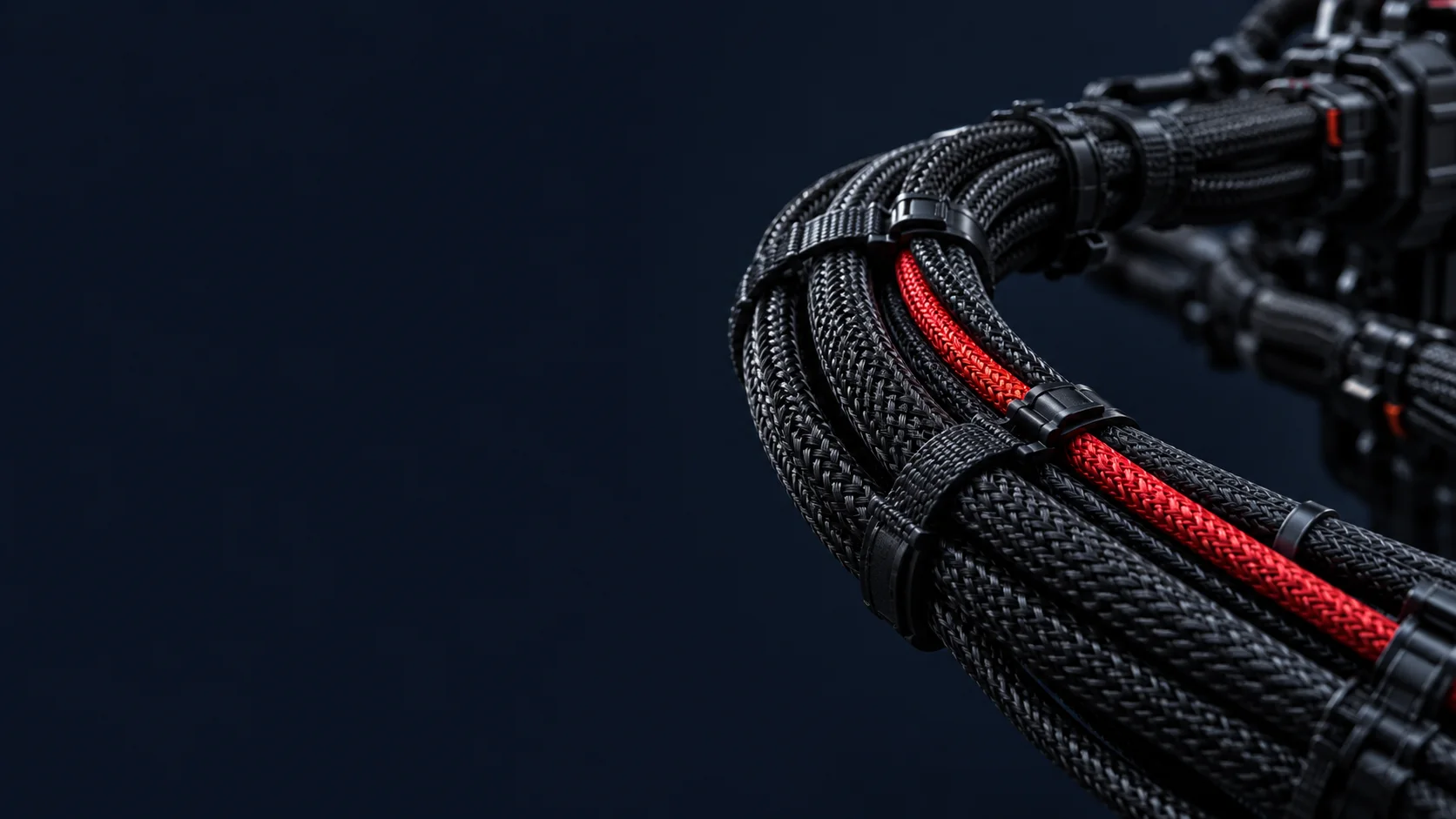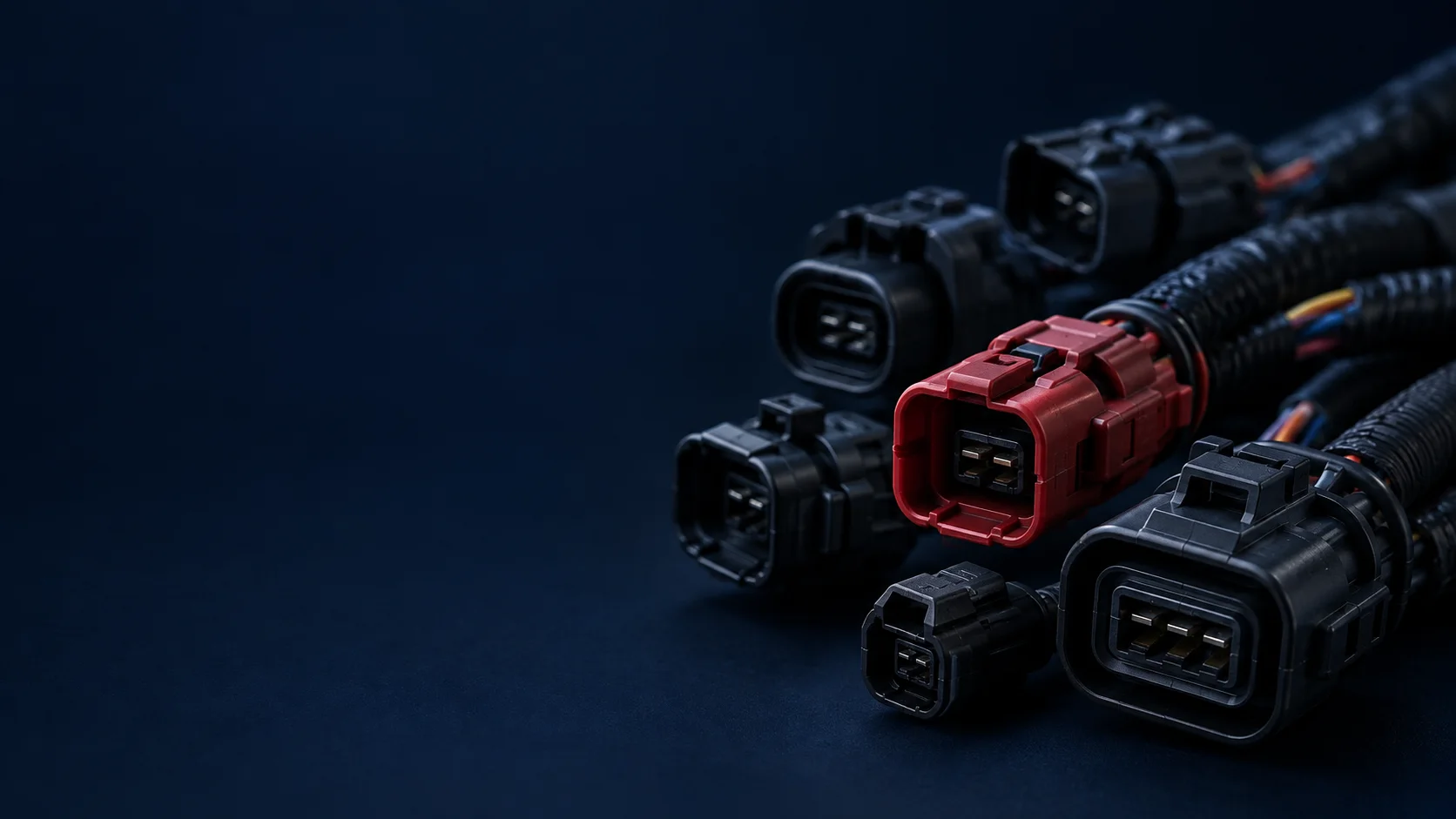
Choose harness protection by the failure it has to prevent, not by the product name. Heat shrink insulates, seals and supports a termination or transition; braided sleeving bundles a harness and resists abrasion while staying flexible; convoluted tubing gives rugged, easy-access routing; tape holds light bundles together and can damp rattle. Each does one job well and the others poorly. This guide shows how to match them to the exposure and how to write the choice on the drawing so the factory builds what you meant.
Every figure below comes from a manufacturer's published specification, named at the point of use. Product limits differ by series and revision, so treat the numbers as examples of what to look for and confirm them on the datasheet for the part you select.
Make the decision from three viewpoints
- Design: list what the harness meets: abrasion against edges, heat, fluids, moisture, vibration and service access. Pick the covering that addresses the worst exposure on each segment, and keep the route in mind (see the strain relief and routing guide).
- Manufacturing: check that the covering can be installed in the build sequence. A heat-shrink sleeve must go on before a connector is fitted if the connector is larger than the sleeve opening; a split tube can go on after.
- Procurement: buy by manufacturer part number, temperature rating and size, not by “sleeve”. Ask how any substitute changes diameter, temperature rating or flame rating before accepting it.
The four coverings compared
| Covering | Best used for | Published specifics (examples) | Watch out for |
|---|---|---|---|
| Heat-shrink tubing | Insulating and sealing splices, connector-to-cable transitions, labels and local support | TE describes single-wall tubing for mechanical protection and chemical resistance, and dual-wall tubing with an adhesive or encapsulant inner wall for sealing out moisture | Needs heat to install; a size that is too small or overheating can split it; heating must reach the substrate |
| Expandable braided sleeving | Flexible bundling and abrasion protection along a harness run | HellermannTyton lists an expandable PET braid with a -70 to +125 °C range that expands to 150% of nominal diameter and has medium abrasion resistance | It is a protective covering, not a seal and not an EMI shield; fraying at cut ends needs a plan |
| Convoluted (split) tubing | Rugged routing where the harness must be opened for service or added to later | HellermannTyton lists a flame-retardant polypropylene version for -40 to +125 °C, self-extinguishing within 60 seconds, with a split side for installation | Bulkier than braid or tape; the split must be closed or oriented away from the exposure |
| Harness tape | Light bundling, securing and noise damping inside enclosures | tesa classifies its tapes by noise damping and abrasion resistance classes A to E (see below) | Adhesive and film must suit the temperature; tape alone is not a seal or strain relief |
Heat shrink: size it, then install it by the book
TE's selector starts from three questions: whether you need a flame-retardant product, whether you need to seal from moisture, add strain relief or provide rigorous mechanical protection, and what continuous operating temperature range is required. Answer them before you look at diameters. TE's overview of its tubing line, as listed by Mouser, separates single-wall tubing, which gives mechanical protection and chemical resistance, from dual-wall tubing whose adhesive or encapsulant inner wall seals out moisture. If sealing is a requirement, say “dual-wall, adhesive-lined” on the drawing; a plain single-wall sleeve is not specified as a seal.
For size and installation, TE's Application Specification 114-120022 (Rev A) gives practical rules for general-purpose single-wall tubing:
- Select the largest tube size that fits the substrate snugly, without forcing it. A larger tube gives a thicker installed wall and better protection.
- Cut cleanly with a sharp knife. The specification warns that an improper cut or scissors can nick the tube and lead to a split.
- Heat progressively from one end with even heat, rotating the assembly or the gun, and avoid trapping air. Do not finish both ends and meet in the middle.
- Do not touch the tube with the gun or overheat it. Stop if it blisters or chars. Metal substrates draw heat away and take longer than plastic.
- Accept the result only if it is free of cold spots and wrinkles and conforms to the substrate.
TE lists the usual causes of a tube that splits: an overheated tube, a loose wire strand, or the wrong size. It also lists the wrong tube size as a cause of a tube that does not fully shrink onto the substrate, so use the size table rather than guessing. For installation, TE names a heated air-circulating oven, a heat gun or a belt heater; the right one depends on the substrate and volume, so state your method in the process plan, not on the part drawing.
Hypothetical example: sizing a sleeve over a 12 mm connector
Assume a connector body 12 mm across and a 6 mm cable, and a 3:1 tube whose datasheet gives a 14 mm expanded inside diameter. These are assumed inputs, not a specific TE part. Check the fit both ways: the expanded diameter must pass the largest object, 14 mm > 12 mm, which leaves 2 mm of clearance; and the recovered diameter must be smaller than the smallest object. At 3:1, the nominal recovered diameter is 14 mm ÷ 3 ≈ 4.7 mm, which is less than 6 mm, so the tube can fully grip the cable.
Now try a 2:1 tube whose expanded diameter only just clears the connector, say 13 mm. It recovers to about 13 mm ÷ 2 = 6.5 mm, which is larger than the 6 mm cable, so it cannot grip the cable at all. A higher ratio is the safer starting point. The datasheet's actual expanded and recovered diameters, including the recovered wall thickness, decide the final choice.
Braided sleeving: abrasion cover, not a seal
Expandable braided sleeving slips over a bundle, stretches to fit and flexes with it. For example, HellermannTyton's expandable PET braid, as listed in the Jameco catalog, has a -70 to +125 °C range, expands to 150% of its nominal diameter, and has medium abrasion resistance. Other listings offer fray-resistant and flame-retardant versions, so name the exact part rather than the type.
Size from the stated range, not from the nominal size. A listing for a 0.25 in (6.35 mm) size gives a nominal diameter range of 3.18 to 9.53 mm. Measure the largest bundle diameter, including any connector the sleeve must pass over, and check it against the range for each candidate size.
Two cautions. A protective braid does not shield against electrical noise: if the requirement is EMI, read the shielding guide and specify a shield. And the ends need finishing, because cut braid can fray; ask for the end-finishing method (for example, a fray-resistant part or sealed ends) to be named in the build instruction.
Convoluted tubing: rugged and serviceable
Convoluted tubing, often called split loom, is a corrugated tube with a slit down the side. The slit lets you insert or add wires without taking the harness apart. The HellermannTyton flame-retardant polypropylene version is listed for -40 to +125 °C and self-extinguishing within 60 seconds, with a higher temperature range than the same maker's polyethylene tubing. Use it where a harness is exposed to vibration wear, weather or heat and may need service access, and choose the material for the temperature and flame requirement. Plan how the split is oriented and closed (for example by taping or tying) so that it is not facing the abrasive surface.
Harness tape: read the class, not the name
Tape bundles light harnesses and can reduce rattle. tesa's wire harnessing guide classifies its tapes by noise damping and by abrasion resistance, each from Class A to Class E, following the LV 312 classification:
| Class | Noise damping requirement | Abrasion resistance | Strokes (abrasion test) |
|---|---|---|---|
| A | 0 to 2 dB(A) | No resistance | fewer than 100 |
| B | over 2 to 5 dB(A) | Little | 100 to 499 |
| C | over 5 to 10 dB(A) | Medium | 500 to 999 |
| D | over 10 to 15 dB(A) | High | 1,000 to 4,999 |
| E | over 15 dB(A) | Very high | 5,000 or more |
Within the same guide, tesa 4182 PV2 is a 104 µm PVC film tape rated to 105 °C with Class A noise damping and abrasion, while tesa 51025 PV10 is a 160 µm PET cloth tape rated to 125 °C with Class A noise damping and Class A or B abrasion depending on the mandrel size. The tesa 4182 PV2 page lists a -25 to 105 °C range. The point is that two tapes can look alike and sit in different classes; ask for the class and temperature rating, and remember LV 312 is an automotive classification, so use it as a common language for comparison rather than as proof for another industry.
Match the covering to the exposure
| Exposure on the segment | Reasonable starting point | Specify on the drawing |
|---|---|---|
| Moisture at a connector exit or splice | Dual-wall, adhesive-lined heat shrink, or an overmold where the design needs one | Dual-wall part number, expanded and recovered diameters, required seal, how it will be verified |
| Rubbing against edges or other harnesses | Braided sleeving or abrasion-rated tape | Part number, size range, end-finishing method, tape class |
| Heat near a source | A covering whose rated range is above the expected temperature; move the route if you can | Operating temperature and the material that meets it, verified on the datasheet |
| Rugged route that may be opened for service | Convoluted split tubing | Material, size, split orientation, closing method |
| Rattle inside an enclosure | A tape with a higher noise damping class | Tape part number and noise damping class |
Do not assume one covering covers every exposure: heat shrink on a connector exit still needs a strain-relief decision, and a braid over a splice is not a seal. For sealed harnesses, read the waterproof harness guide for how seals, glands and overmolds work with the covering, and see overmolding where an overmold replaces a sleeve.
What to put on the drawing and in a Philippines factory RFQ
For a harness RFQ to XUDONG in Cavite, Philippines, make these items explicit so the process can be reviewed before the first build:
- Covering list: each tube, sleeve, tape and tie by manufacturer part number, with the segment it covers.
- Heat shrink: single or dual wall, expanded and recovered diameters, recovered wall if it matters, temperature range, flame requirement, and the installation method (heat gun, oven or belt heater).
- Sleeving and tubing: material, size range against your measured bundle, end-finishing method, and split orientation.
- Tape: part number, noise damping and abrasion class, temperature class and where it may be used.
- Acceptance: what a good installation looks like (for example, no splits, no cold spots or wrinkles for heat shrink), who inspects it, and any required tests defined through the testing review.
- Substitutes: approved alternates and the approval route, linked to the labeling and traceability plan.
Send the package through the RFQ page, or see our Philippines specialty cable page for the cable side of the same build, and the wire harness blog hub for related design questions.
FAQ
Is heat shrink waterproof?
Only when it is a sealing type used correctly. TE describes dual-wall tubing with an adhesive or encapsulant inner wall as the version that seals out moisture; a general-purpose single-wall tube is described for mechanical protection and chemical resistance. If you need a seal, specify the dual-wall part, the installation and how the seal will be verified for your requirement.
Heat shrink or braided sleeving: which should I use?
Use heat shrink where you need to insulate, seal or support a transition or splice. Use braided sleeving where you need flexible abrasion protection or bundling along a run. They are often used together on one harness.
Can I install heat shrink with a heat gun?
TE names a heated air-circulating oven, a heat gun or a belt heater, depending on the application. With a gun, heat from one end with even movement, keep the tip off the tube, and stop at any sign of blistering or charring. The factory process plan should state the method.
What temperature rating should a covering have?
Choose one whose rated range comfortably includes the highest temperature the segment will see, including nearby heat sources, and check that the cable and the covering are compatible. Read the rating from the datasheet for the exact part rather than the material type.
Does braided sleeving shield against EMI?
No. A protective sleeve is a mechanical covering. EMI shielding is a conductive layer specified and terminated as part of the cable or harness design; see the shielding guide for foil, braid and grounding choices.
What do tape classes A to E mean?
Under the LV 312 classification as tesa reports it, noise damping and abrasion resistance are each graded A to E. For example, abrasion Class A means no resistance (fewer than 100 strokes in the test) and Class E means very high (5,000 or more). Ask for the class of the exact tape.