“Waterproof” is not one thing you buy — it is an IP (Ingress Protection) rating, and a wire harness is only as sealed as its weakest point. A single unsealed cavity, a missing wire seal, or an unmated connector can drop a beautifully overmolded assembly from “submersible” to “splash-resistant.” This guide explains what the common ratings actually mean, the real ways a harness is sealed, the weakest-point rule that decides the true rating, typical targets by application, and how to specify and verify an IP-rated harness on an RFQ.
It is written for engineers and buyers specifying a sealed harness for the first time — enough to set a realistic target, brief a supplier, and read a quote. Behind our Philippine assembly, the sealing and connector experience comes from the same Hebei Cloom (CLOOM) engineering base, so the methods below reflect real production practice rather than catalog copy.
What IP ratings actually mean
An IP rating (from IEC 60529) has two digits. The first digit is protection against solids: 6 means fully dust-tight. The second digit is protection against water, and it is the one that matters for “waterproof”:
- IPX4 — splashing water from any direction.
- IPX5 / IPX6 — water jets / powerful water jets.
- IPX7 — temporary immersion, typically up to 1 m for 30 minutes.
- IPX8 — continuous immersion, at a depth and duration agreed with the maker.
- IPX9K — close-range, high-pressure, high-temperature jets (washdown).
So IP67 means dust-tight and good for a 30-minute dunk; IP68 means dust-tight and rated for continuous immersion; IP69K means dust-tight and able to take high-pressure steam cleaning. Note that a higher second digit is not always a superset of a lower one — a part rated IP67 is not automatically IP69K — so state every rating you need. “Waterproof” with no number attached is not a specification.
How a wire harness is actually sealed
Sealing a harness is a set of methods, usually combined, and each one guards a specific leak path:
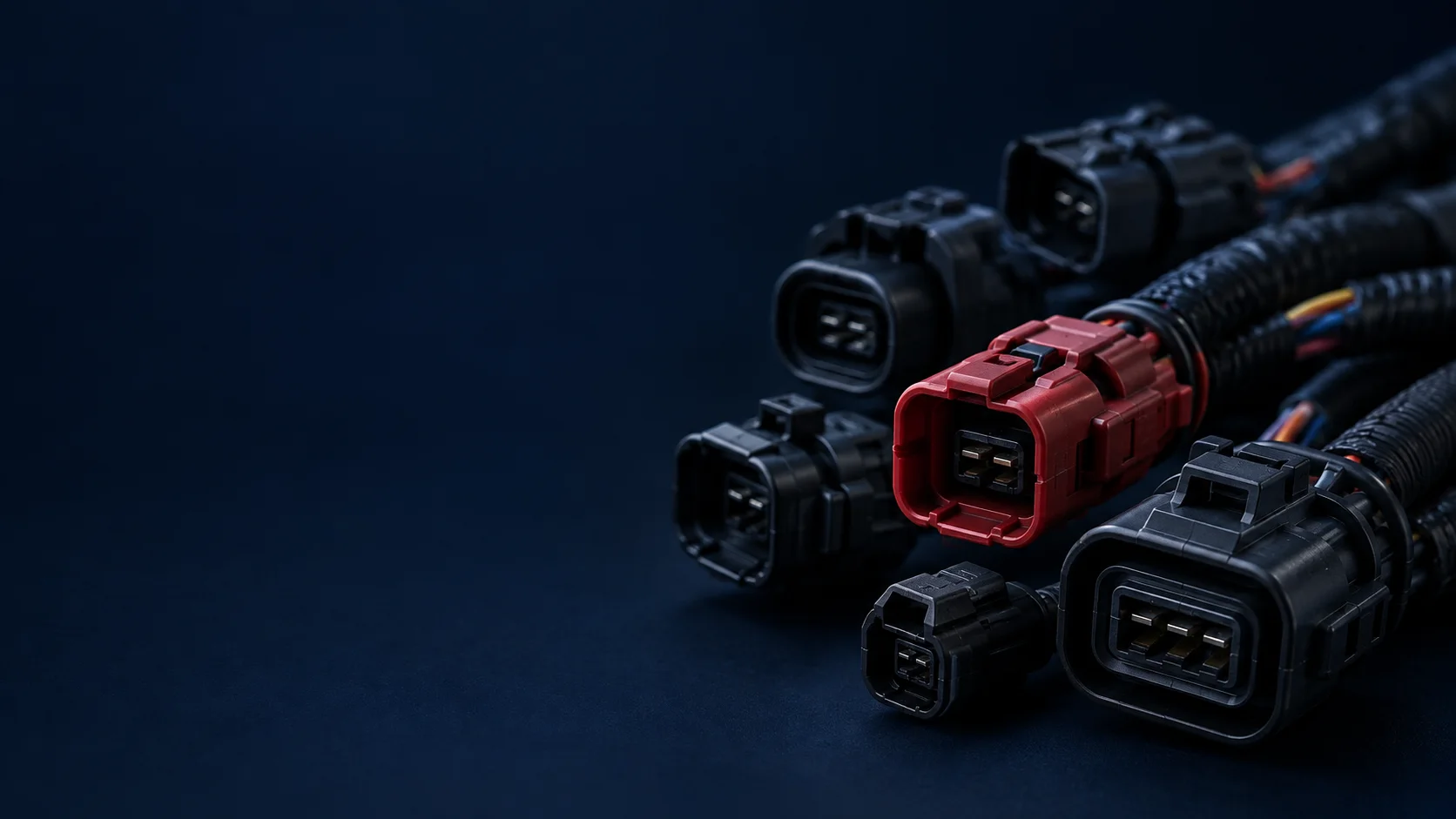
- Sealed connectors. Series such as sealed automotive and industrial connectors carry an interface seal at the mating face, a wire seal on every populated cavity, and a blanking plug in every unused cavity. Miss one wire seal or one empty cavity and the connector leaks — this is the most common real-world failure.
- Overmolding. A molded boot shot over the cable-to-connector junction gives a one-piece, fully sealed transition that can reach IP67, IP68, or IP69K. See overmolded vs potted cable assemblies for how it compares with potting.
- Potting. A curable resin poured into a backshell or cavity fills every void and seals the termination, ideal for low volume and awkward geometry.
- Cable glands and grommets. At an enclosure or panel entry, a gland or sealed grommet holds the ingress rating where the cable passes through the wall.
- Adhesive-lined heat shrink. For splices and small transitions, dual-wall heat shrink with an internal adhesive seals against moisture wicking down the cable.
The weakest-point rule
The rating of the whole harness is set by its least-sealed feature, not by its best one. An IP68 overmold at one end means nothing if the connector at the other end is missing a cavity plug, if the wrong wire seal was used for the conductor diameter, or if the cable jacket lets water wick internally down the strands to an unsealed splice. When you specify a harness, specify the rating at every interface — both connector ends, every splice, and every panel entry — and confirm that unused cavities are plugged. A sealed harness is a chain, and water finds the one weak link.
Typical targets by application
The right rating comes from where the harness lives, not from asking for the highest number available:
- Automotive underbody and engine bay — commonly IP67 to IP6K9K, because parts see splash, spray, and sometimes pressure washing. This is the world of our automotive wiring work.
- Outdoor, solar, and renewable — often IP67/IP68 for junctions exposed to rain and standing water; see solar and renewables.
- Industrial washdown (food, pharma, packaging) — IP69K, because equipment is cleaned with high-pressure hot water.
Higher ratings cost more in connectors, sealing labor, and test, so match the target to the environment. For sealed cable used across these settings, our specialty cable and industries pages show where sealed assemblies fit.
Serviceable or permanent?
Decide early whether the sealed joint must open again. A sealed connector unmates and remates, so the harness is serviceable — you can disconnect it for repair or replacement. An overmold or potted joint is permanent: it fully encapsulates the termination, so a failure is replaced, not opened. Neither is right or wrong, but the choice belongs in the specification so no one expects to rework a sealed part in the field.
Representative project (anonymized). A North American energy-management customer needed to validate a complex custom overmolded power cable design before committing to production tooling. Hard overmold tooling is costly and slow for a handful of NPI units, so the approach was a rapid silicone soft-mold: 50 pieces of raw material were allocated to build an initial batch of 5 sample units, delivered in a 3–4 week turnaround (including about 2 weeks to create the silicone mold). That let the customer physically test the sealed design and iterate before spending on hard tooling — the same prototype-before-you-tool discipline that keeps sealing problems from surfacing after the money is spent.
How to specify and verify it
Put the following on the RFQ, and the seal becomes a defined, testable requirement rather than a hope:
- The IP rating(s) you need, at every interface, with immersion depth/duration or jet spec if relevant.
- The connector series and whether the joint must be serviceable or can be permanent (overmold/pot).
- The temperature range and any chemical, fuel, or coolant exposure, so the seal material is matched to it.
- Confirmation that unused cavities are plugged and correct wire seals are used for each conductor size.
Then verify it. A stated ingress rating should be backed by the appropriate seal check, alongside the electrical and mechanical acceptance tests every harness gets — continuity, insulation resistance or HiPot where specified, and a pull test on the strain relief. Those methods are covered in our guide to wire harness testing — continuity, HiPot, and pull force, and choosing the right sealed connector starts with wire harness connector selection. Sealing is only real when it is tested: the acceptance test is what proves the IP rating you specified is the one you actually got.